
JTBD Framework Fundamentals
Deep dive into the core principles and methodology of Jobs To Be Done (Advanced Content)
💡 New to JTBD?
This is advanced content. If you're new to Jobs To Be Done, start with What is JTBD? or How RoleDream Connects Them.
The Theory Behind JTBD
Jobs To Be Done theory, created by Tony Ulwick in 1990 and later popularized by Clayton Christensen, fundamentally changes how we think about innovation and customer needs. It's based on the insight that customers don't buy products—they "hire" them to do specific jobs.
psychology Jobs Drive Behavior
People's purchasing decisions are driven by the job they need to accomplish, not by customer demographics or product attributes.
timeline Jobs Are Stable
While technologies and solutions change rapidly, the fundamental jobs people need to accomplish remain relatively stable over time.
place Context Matters
The same person may have different job requirements in different contexts, leading to different solution preferences.
Historical Context
Tony Ulwick created JTBD theory in 1990 after experiencing product failures at IBM. Clayton Christensen later popularized it through his books on disruptive innovation, bringing it to mainstream business audiences.
Anatomy of a Job
Job Statement Structure
Situation (When)
The context or circumstances that trigger the need for the job
Motivation (I want to)
The functional, emotional, or social job to be accomplished
Outcome (So I can)
The desired end result or benefit the customer seeks
Job Hierarchy & Relationships
Jobs nest: overarching life goals decompose through big objectives and everyday tasks down to immediate actions. Products usually attach at the bottom two levels — the best innovations understand the levels above.
Using the Level Field in RoleDream
When creating or editing a job on the Blueprint, use the optional Level field to classify where your job sits in the hierarchy. Enter "Life", "Big", "Little", or "Micro" (or your own custom level labels). The level is stored with the job and is visible when you open the job form; it is not shown on the job card itself.
Types of Jobs (Deep Dive)
Functional Jobs
The practical, utilitarian tasks customers need to accomplish
Characteristics:
- • Objective and measurable
- • Clear success criteria
- • Often time-bound
- • Process-oriented
Examples:
- • "File my tax return accurately"
- • "Get from home to work quickly"
- • "Find a reliable contractor"
- • "Backup my important files"
Emotional Jobs
The feelings and emotional states customers want to achieve
Characteristics:
- • Subjective and personal
- • Often subconscious
- • Highly contextual
- • Drive loyalty and preference
Examples:
- • "Feel confident and prepared"
- • "Reduce anxiety about the future"
- • "Feel entertained and engaged"
- • "Maintain a sense of control"
Social Jobs
How customers want to be perceived by others
Characteristics:
- • Identity and status-driven
- • Influenced by culture and trends
- • Group and context dependent
- • Often visible to others
Examples:
- • "Be seen as environmentally conscious"
- • "Appear tech-savvy and current"
- • "Demonstrate good parenting"
- • "Show professional competence"
Forces Acting on Jobs
Understanding the forces that influence job execution helps predict customer behavior and design better solutions.
push_pin Push Forces (Motivating)
Problem Urgency
How pressing is the need to solve this job?
Problem Magnitude
How big of an issue is this for the customer?
Solution Attractiveness
How appealing is the proposed solution?
block Blocking Forces (Habit & Anxiety)
Status Quo Comfort
Preference for familiar current solutions
Switching Costs
Time, money, and effort required to change
Solution Anxiety
Concerns about new solution risks
How RoleDream Supports JTBD
Framework Implementation
The Blueprint Canvas
Jobs, their competing solutions, step trees, and staged resources on one connected surface
Segments
Group customers by job similarity rather than demographics, and link them to their jobs
Research as Evidence
Link interviews and observations to the jobs they document — quotes live here, not in descriptions
Solution Step Analysis
Break each solution into ordered steps and sub-steps, with parallel work on separate branches — the process detail lives here
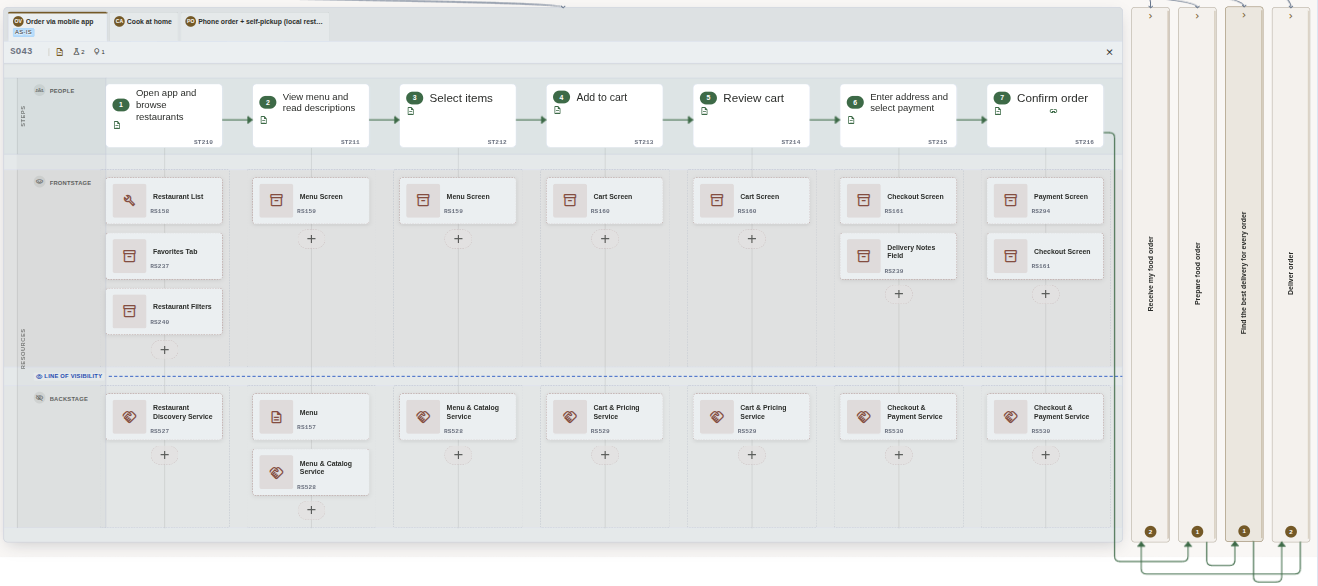
JTBD in practice on the Blueprint: one job's competing solutions as tabs, the hired one active with its step sequence and staged resources. (Click to zoom)
shopping_cart The Hiring Model
You don't "hire" a job — jobs exist whether you do them or not. You "hire" a solution to accomplish the job. This distinction is fundamental to JTBD.
Job (Stable Goal)
The enduring need that doesn't change over time.
Solution (What Gets Hired)
The approach that can be hired/fired to accomplish the job.
Solution Steps (Process)
The specific steps for a particular solution.
HiringDecisions Track What Works
HiringDecisions record when solutions are hired, fired, or switched. This tracks what works or fails for accomplishing jobs.
badge The Delivery Perspective
While JTBD focuses on why customers need something, RoleDream adds a complementary perspective: how the people and systems on the delivery side meet those needs.
How Segments Reach the Work
Segments Reach Jobs
Link each segment — a customer group, a team, a single position — to the jobs it performs or needs done, and chain segments only where one really breaks down into the other. Selecting a segment on the Blueprint lights that whole flow
Solution Steps Define Process
Each solution breaks into ordered steps and sub-steps, branching where work runs side by side — how the work actually gets done
Resources Stage Under Steps
Each step's tools and systems sit in the Frontstage or Backstage lane — the line of visibility
Coffee Shop Example
Baristas — deliver the service
Morning commuters — who the baristas serve
Get energized for the day
Espresso-based coffee drink
- Greet customer (input: customer arrival)
- Take order (output: order ticket)
- Grind beans (tool: grinder)
- Brew espresso (tool: espresso machine)
- Customize drink (action: add milk/syrup)
- Serve to customer (output: completed drink)
Espresso machine, Grinder, POS system, Cups